Carbohydrate counting is a flexible way to plan your meals. It focuses on foods that contain carbohydrates (carbs) as these raise your blood sugar the most.
Counting how many carbs you are planning to eat can help keep your blood sugar at healthy levels. You will find carbs in a range of different foods including starchy foods such as grains (think breads, cereals, pasta and quinoa), legumes (think chickpeas and lentils), and some vegetables (think potatoes and corn), as well as fruits, and dairy products such as milk and yogurt. You will also find them in foods to which sugar has been added, including baked goods (like cake and cookies), sugary beverages, and candy.
Follow these steps to count carbs and help manage your blood sugar levels. Your registered dietitian or certified diabetes educator can guide you along the way.
STEP 1 Make healthy food choices
Enjoy a variety of vegetables, fruits, whole grains, low fat milk products, and meat and alternatives at your meals. A variety of foods will help meet your nutrient needs.
Use added fats in small amounts. This helps to reduce your risk of heart disease.
Choose foods low in sodium and avoid adding salt when cooking to help prevent and manage high blood pressure.
STEP 2 Focus on carbohydrate
Your body breaks down carbohydrate into sugar (glucose). This raises your blood sugar levels.
Carbohydrate is found in many foods including grains and starches, fruits, some vegetables, legumes, milk and milk alternatives, sugary foods and many prepared foods.
Meat and alternatives, most vegetables and fats contain little carbohydrate.
Moderate servings of these type of foods will not have a big effect on blood sugar levels.
STEP 3 Set carbohydrate goals
Your dietitian will help you set a goal for grams of carbohydrate at each meal and snack. This may be the same from day to day or may be flexible, depending on your needs, your health goals and if you take medication or insulin to manage your diabetes.
Most people aim for 45–60 grams (g) carbohydrate at meals and 15– 30 g carbohydrate at snacks.
Try to meet your target within 5 g per meal or snack.
STEP 4 Determine carb content
Write down what you eat and drink throughout the day.
Be sure to note the portion sizes. You may need to use measuring cups and spoons to be accurate.
Record the grams of carbohydrate in these foods and drinks.
To find the carb content of foods, check food packages, food composition books, restaurant fact sheets and websites.
STEP 5 Monitor effect on blood sugar level
Work with your healthcare team to correct blood sugar levels that are too high or too low.
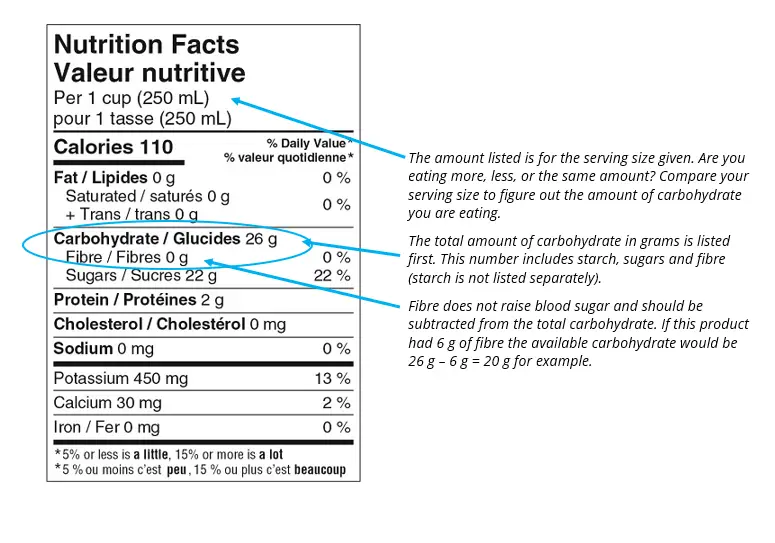
Finding carbohydrate values using the Nutrition Facts table
Locate the Nutrition Facts Table: Look for the "Carbohydrate" section.
Check the Serving Size: The amount listed is for the serving size given. Are you eating more, less, or the same amount? Compare your serving size to figure out the amount of carbohydrate you are eating.
Identify Total Carbohydrates: The total amount of carbohydrate in grams is listed first. This number includes starch, sugars and fibre (starch is not listed separately).
Subtract Fibre: Fibre does not raise blood sugar and should be subtracted from the total carbohydrate. If this product had 6 g of fibre the available carbohydrate would be 26 g – 6 g = 20 g for example.
0:00
foreign
0:08
I'm so pleased that you're joining us
0:11
today
0:12
diabetes deep Dives is a series of
0:14
videos designed to dive deeper and
0:16
Beyond the surface of different areas of
0:18
diabetes management we are exploring
0:20
those burning questions that you may
0:22
have by featuring Dynamic and engaging
0:24
guests with knowledge or lived
0:26
experience on the topic our goal is to
0:29
share information in ways that will
0:30
spark continued interest and learning
0:32
and leave you with practical tips and
0:35
tools that you can easily use
0:37
we'll be dropping a new video every
0:39
month so subscribe to our YouTube
0:41
channel and click on the notification
0:42
Bell to be notified about new content
0:44
you can also check us out on social
0:47
media to find out when the next one will
0:49
be posted to our YouTube channel
0:51
just a reminder that the information
0:53
shared in these videos in no way
0:55
replaces the advice and direction from
0:57
your Healthcare team if you have
0:59
questions about your care please speak
1:01
to your healthcare provider and team to
1:03
make sure that you are getting the best
1:04
advice
1:06
in this episode our guest speaker
1:08
Gabrielle Schmid will offer her
1:10
practical advice on navigating the
1:12
complex world of counting carbs when
1:14
enjoying your meals with different
1:16
ingredients all mixed together
1:18
Gabrielle will walk us through the key
1:19
learnings that we hope you will get from
1:21
this video
1:23
Gabrielle is a registered dietitian
1:25
certified educator and pump trainer she
1:28
currently works at LMC Healthcare as a
1:31
diabetes educator and clinical
1:33
coordinator for the diabetes education
1:35
program
1:36
she has been living with type 1 diabetes
1:38
for 25 years and ultimately she is
1:40
passionate about driving change in the
1:42
healthcare provider approach to help
1:44
Empower all people living with diabetes
1:49
we hope that you will find this video
1:50
informative and that it will support you
1:52
in managing your blood sugar while
1:54
enjoying your favorite mixed dishes and
1:56
now over to Gabrielle
Welcome
1:59
hi everyone and welcome to diabetes
2:01
Canada deep Dives today's topic is tips
2:03
and tricks on carb counting my name is
2:06
Gabrielle Schmid I'm a registered
2:07
dietitian and certified diabetes
2:10
educator in Ottawa
2:11
so let me first start by saying that
2:13
curb counting is a very difficult skill
2:15
to learn you may have learned this early
2:17
on in your diagnosis or maybe you're
2:19
learning this for the first time but
2:21
when we learn crowd counting we learn
2:22
about food labels looking at the grams
2:24
of carbs subtracting our fiber for a
2:26
total amount of carbs or maybe learning
2:29
how to use a food scale but what if our
2:31
environment changes right we don't have
2:32
access to these food scales and food
2:34
labels in a restaurant out with friends
2:36
Etc so today I want to help teach you
2:39
some tips and tricks to help you learn
2:41
more about practical skills so we're
2:43
going to learn practical carb counting
2:45
methods how fat protein and the glycemic
2:47
affects carb Counting hidden sources of
2:50
carbs how to make a best guess when carb
2:53
counting using technology to help and
2:56
Insulin strategies
Practical Methods
2:58
so here we're looking at practical
3:00
methods so you'll see on the left hand
3:02
side actually two in one so we're
3:04
looking at both the plate method and
3:06
also a visual like using your hand so if
3:09
you're looking at the plate method here
3:11
you'll see that in the plate you're
3:13
divided in three you have your grains
3:15
and starches in one quart of the plate
3:17
protein in the other quarter of your
3:19
plate and half your plate is vegetables
3:21
although this might not be new to you
3:24
you can actually use this method let's
3:26
say in a restaurant right you can order
3:27
a dish that might mimic this and it
3:29
might help you look at it and understand
3:31
more about your
3:32
carbohydrate portions
3:34
um so looking at your corner of your
3:36
plate now maybe the restaurant plate is
3:37
much bigger but at least you have a
3:39
better understanding of how much
3:41
carbohydrate is in your plate versus a
3:43
mixed dish or something like that
3:45
at the same time you can see the hand so
3:48
beside the graves and starches you have
3:50
a fist so that once this tier you're
3:52
looking about a cup of food so if you
3:54
have a big plate at the restaurant and
3:56
you think you have about two fifths of
3:58
food that's approximately two cups so
4:00
then you can do the math in terms of
4:01
what you think the carb count is
4:04
another practical method that I like to
4:06
use is actually using a dry measuring
4:08
cup to actually serve the food on
4:10
someone's plate or my own plate so
4:12
instead of using like a ladle or a big
4:14
spoon I don't know how much that later
4:16
that spoon is actually going to give me
4:17
in terms of the amount of food but if I
4:20
actually use
4:21
um a one cup measuring cup I know that
4:23
I'll be serving myself one cup of food
4:25
and I can do my curb counting a little
4:27
easier that way so using a dry measuring
4:29
cup is actually quite useful for
4:31
actually serving the food on someone's
4:32
plate same thing for liquids if you
4:35
actually want to measure the amount of
4:38
liquid going into a smoothie for example
4:39
maybe pouring it up in a measuring cup
4:42
to see how much milk you're getting or
4:44
fruit Etc to give you a better sense of
4:47
the amount of carbohydrate
Hand Visuals
4:51
here's another document to show you more
4:54
visuals so just understanding more
4:56
household objects versus your hand but
4:59
certainly you may not have access to
5:00
these things if you're at a restaurant
5:01
but you have your hand right so looking
5:04
in at your fist was again one cup the
5:07
palm of your hand is about a quart or
5:09
half a cup sorry
5:11
um the Palm here
5:13
is about three ounces a handful another
5:17
ounce so looking at different ways to
5:18
use your hand to look at you know uh how
5:21
much I may be eating in my plate of food
5:23
you could even maybe print this off and
5:25
have it handy for the first couple of
5:26
times just because you may not be sure
5:29
um but you'll get used to it so if you
5:30
start using this now even at home when
5:32
you're in a restaurant or someone else's
5:34
house to eat it might get easier over
5:36
time
5:37
so looking at both household objects and
5:39
also your hands could be another
5:40
practical tip to help you with your carb
5:42
counting a little more accurately
Non Carbs
5:46
so what about non-carbs so we know that
5:48
when we eat carbohydrate if we just eat
5:50
the carbohydrate alone it's pretty
5:52
predictable how it might act in the body
5:54
but if I have something that's high fat
5:56
and high protein with the carb food it's
5:59
actually going to slow down the
6:00
absorption of the carb so if I take
6:02
insulin for my carb counting and I think
6:05
you know when I eat it alone and I think
6:07
that it's going to work within two hours
6:09
Etc it might not be the same thing when
6:12
we're actually adding something like
6:13
cheese or something that's deep fried or
6:15
something of that sort you may have that
6:17
experience yourself when you in
6:19
something like pizza or nachos right the
6:22
spaghetti or the noodle itself or the
6:24
chip itself uh maybe the chip because
6:26
it's higher in fat but let's say the
6:28
noodle itself is pretty predictable in
6:30
terms of how it affects your sugar but
6:32
when you add a lot of that cheese or a
6:34
lot of that meat sauce it might change
6:36
the way that it works so looking at
6:38
strategies to help you with that could
6:39
be either using the extend bolts feature
6:42
if you're using an insulin pump if
6:44
you're on injections you might want to
6:45
split urine injection in two and of
6:48
course discussing this with your
6:49
diabetes team to help you learn more
6:51
about those features and understanding
6:53
how to split your injection
6:55
but just understanding the fact that you
6:57
know if I have a plate of food and it
6:59
seems to be quite high fat high protein
7:01
the outcome is going to be different
7:02
than if you're just having a
7:04
carbohydrate with more predictable food
7:05
on the plate like a side salad and a
7:08
small piece of fish or something like
7:10
that
Glycemic Index
7:12
and what about the glycemic index so the
7:15
glycemic index is a way to look at how
7:17
carbohydrate is going to impact the
7:19
sugar just the carbohydrate alone so an
7:21
example would be let's say bread if I'm
7:24
eating a white uh bread or one slice of
7:26
white bread my blood sugar might Spike
7:28
fast versus if I have something like
7:31
sourdough bread or rye bread
7:33
surprisingly even though they are still
7:35
white by visually looking at it the way
7:38
that it's made and fermented actually
7:40
it's quite different and so the outcome
7:42
or the absorption of the carbohydrate
7:44
may look differently than just having
7:45
that white bread so if I have to
7:48
pre-bull this let's say for my sandwich
7:49
with white bread I may not need to
7:51
pre-bull this if I'm having something
7:53
with sourdough bread or rye bread
7:55
because the carb even though the carb
7:57
count might be similar it's how the
7:58
carbohydrate is actually behaving in my
8:00
body once I've eaten it so again it's
8:03
not all about carb counting learning the
8:05
grams of carbohydrate but understanding
8:07
kind of what foods do what and when we
8:09
pair it on top of fat and protein again
8:11
right understanding of that there might
8:13
be a change in the outcome of your sugar
Hidden Carbs
8:18
and what about those hidden sources of
8:20
carbohydrate so certainly if you're at a
8:22
restaurant right this is my this might
8:24
be where you might come to face this
8:26
challenge just because if you're at home
8:28
you have more control in terms of what
8:30
you're putting into your recipes
8:32
Etc so if I'm at a restaurant remember
8:34
to look at the sauces the salad
8:36
dressings the condiments the breaded or
8:40
crispy options right those are going to
8:41
be more or higher in carbohydrates so if
8:45
you're having let's say chicken fingers
8:46
right sure the chicken is protein it may
8:49
not be counted but if it's breaded then
8:52
you'll look at not only maybe higher fat
8:54
but also looking at carbohydrate because
8:56
of that breading
8:58
milk Alternatives so not all milk is
9:01
created equally so one cup of cow's milk
9:03
for example is not the same thing as one
9:05
cup of oat milk or if you're looking at
9:08
almond milk so looking at the food label
9:10
because that's often um available to you
9:12
when you are purchasing the milk
9:13
Alternatives but be mindful of that as
9:17
well
9:17
and some nuts and seeds so usually when
9:20
we learn about carb counting we say you
9:22
know don't count your nuts and seeds but
9:24
that's not true not all nuts are created
9:26
equally so looking at cashews for
9:28
example those are actually kind of high
9:31
in carbohydrate depending on the amount
9:32
that you're having but I would actually
9:34
count that towards your carb amount if
9:36
you are eating let's say about a third
9:38
of a cup of cashews compared to if
9:41
you're eating peanuts or almonds
9:43
so here are some examples right so
9:46
ketchup for example a quarter of a cup
9:48
of ketchup often very common when we're
9:50
eating especially during the summer time
9:52
right that can add about 15 grams of
9:54
carbohydrate to your meal but often we
9:57
might forget about it because it doesn't
9:58
visually look like a carbohydrate that
10:00
we might usually count for like the
10:02
bread or a fruit example as example
Technology
10:07
so technology so we're lucky today that
10:10
we live in a world where you know we
10:12
have access to lots of things that are
10:13
fingertips in terms of information and
10:15
that includes carb counting not only
10:18
just carbohydrate but all nutrition and
10:20
nutrients found in our Foods so I often
10:23
tell my patients you know start Maybe by
10:25
Googling it so if you don't have access
10:26
to a food label or a food scale or
10:28
really you're just looking at a plate of
10:30
food and you're not sure but you have
10:31
access to it to your phone you could
10:33
Google it you go in your search bar and
10:35
you just type in something like I don't
10:36
know um strawberries right and then you
10:39
can actually choose the amount of
10:40
strawberries that you're going to be
10:41
eating and it will come up with the carb
10:43
count for that amount of food all as
10:46
well as the fiber and all the other
10:48
nutrition for that food
10:50
the other thing I like to teach my
10:52
patients is the fast foods restaurants
10:54
nutrition information so if you actually
10:56
go on Google and do a quick search I can
10:59
actually do a live demonstration here to
11:01
show you how easy it is so let me just
11:03
stop sharing my screen
11:06
if I go to Google and let's say I'm
11:08
going to Subway for lunch
11:11
okay and then I'm going to click on
11:14
subway
11:24
let's see if I can find it somewhere
11:26
else here
11:28
um
11:31
okay
11:34
so nutrition
11:39
I go down to nutrition data tables
11:41
it's a PDF so you can actually print
11:43
this if you're often going to Subway uh
11:46
you can print this keep this handy ready
11:47
to go you can actually find this in your
11:49
phone as well okay so PDF comes up and
11:52
in the PDF I'll make this a bit bigger
11:54
here you see here the carbohydrate and
11:57
the dietary fiber
11:58
so you can do the math
12:00
okay so if I'm looking at perhaps
12:05
the turkey
12:06
43 minus five so I'm looking at about 38
12:10
grams of carbs first my six inch
12:13
sandwich okay so you can literally like
12:15
I said like I said print this off have
12:17
it handy uh take a picture with your
12:20
phone uh but again keeping track of the
12:22
things that you're often ordering can be
12:24
very helpful and maybe it's once or
12:25
twice a need to look it up and then
12:27
after that you'll know it by heart so
12:29
that's just an information how easy it
12:31
is to find nutrition information your
12:33
carb counting online
12:36
so let me just reshare my screen
12:44
okay perfect the other thing that we can
12:46
do as well is if you again look online
12:48
are Canadian nutrient file has a huge
12:51
array of different foods that we've come
12:53
up with over the years in terms of the
12:54
nutrition available to us so again just
12:57
looking up a certain food you'll find
12:59
all the nutrients related to that food
13:01
including the carb count
13:04
another thing that we all use these days
13:05
for multiple reasons are apps on our
13:08
phone so for example carbs and cows carb
13:11
manager MyFitnessPal Calorie King these
13:14
are examples of carb counting apps so
13:16
you might be already using a diabetes
13:18
app or um not for anything right so
13:21
downloading another app on your phone to
13:23
help with this it's not that you need to
13:25
use it every time that you need to card
13:26
count I mean you can but it could be for
13:29
those things that you're just really not
13:30
sure about there's often big databases
13:32
of different types of foods ethnicities
13:34
all types of foods available to you
13:36
different restaurants even if you travel
13:39
to a different country you'd be
13:40
surprised what you can see there or
13:42
different chains so again using these
13:44
apps uh when you want can really help
13:46
and like I said if you often visit these
13:49
restaurants or have these meals over and
13:52
over again you might need to look it up
13:53
once or twice a few times and then
13:56
you'll know it off by heart after after
13:58
a few times of looking it up
14:00
so these are some of many apps available
14:02
to you these are the most popular that I
14:04
see but certainly looking on your phone
14:06
and looking either in your app store to
14:09
see what's available to you when you
14:10
type in carbohydrate counting you'd be
14:12
surprised what you can see there so take
14:14
a look
Strategies
14:17
so of course when we're carb counting
14:19
we're often doing that to take our
14:20
insulin with our carb ratio or perhaps
14:23
just looking at learning more about
14:24
carbohydrates so we can come up with the
14:26
carb ratio for you so here are some
14:29
strategies to help you with your insulin
14:31
but also to help your insulin work
14:33
better especially when there's a
14:34
situation where you're not sure about
14:35
the carb count
14:36
so consider taking your correction if
14:38
you're a little high before eating so at
14:41
least get some insulin circulating in
14:43
your system if you're really not sure if
14:45
you can't pre-bull this for your meal
14:46
making sure that you have at least a
14:48
correction going in so that you can be
14:50
maybe less above Target when you're
14:53
eating your food again if you can and
14:55
you can remember
14:57
if you're at a restaurant don't pre-bull
14:59
this at a restaurant you don't know
15:00
what's happening in the kitchen there
15:02
might be a fire there someone might be
15:04
delayed whatever it is so really make
15:06
sure that you're only bullisting when
15:08
your plate of food arrives at your table
15:09
then you can take a look at it do some
15:11
calculation maybe looking at your hands
15:14
to see if it mimics the plate method or
15:15
whatever it is and then bolus when you
15:18
have a better understanding of your card
15:19
count and again when it's in front of
15:21
you
15:22
use your extend Bulls feature on your
15:24
pump like we talked about in terms of
15:26
high fat high protein certainly a
15:28
situation that would happen more often
15:29
in a restaurant and if there's something
15:31
that you're often eating in a restaurant
15:33
that you really want to get correct in
15:35
terms of bolusing maybe discussing this
15:37
with your diabetes team taking notes so
15:40
maybe the first time you're not actually
15:42
using extendable list you just take a
15:43
you take your insulin as you usually
15:45
would and see what happens to your sugar
15:47
and then maybe you'll see that maybe in
15:49
four hours or six hours you need more
15:51
insulin well we can use the extend Bulls
15:53
feature to help you with that
15:56
be careful it's better to underestimate
15:59
than to overestimate when we're looking
16:00
at our carb count I would say if you're
16:02
really not sure give it a guess but try
16:05
to guess a little lower than maybe what
16:07
you think is actually in your plate
16:09
um so better to do that than to overdo
16:11
it and then have too much insulin on
16:12
board and cause a low
16:15
if you're really not sure bullets for
16:17
some right or half if you think of an
16:19
idea of how much it is Monitor and
16:22
adjust as needed we can always give
16:24
Corrections later on but certainly you
16:26
want to give it enough time you don't
16:27
want to give a correction half an hour
16:29
after eating you want to at least wait
16:31
two three four hours to give your
16:33
correction
16:34
um so just keep that in mind just give
16:36
some before if you can
16:39
um and if you have no idea you can eat
16:42
your plate of food think of how much you
16:44
ate and go from there right some insulin
16:46
is better than no insulin
Summary
16:50
so I hope that today we learned about a
16:53
few things ultimately we know carb
16:55
counting is hard work we never expect
16:56
Perfection you shouldn't as well right
16:59
that is a lot of work to just do that
17:01
um so be mindful of that skill use your
17:04
hands or visuals to help you understand
17:06
your portions like we talked about those
17:08
household items if you have them around
17:09
but certainly using your hand is good
17:11
enough
17:12
model the plate method at a restaurant
17:14
when possible so if you're at a
17:16
restaurant and you want to order
17:18
something if you can see if it fits more
17:20
into that plate method versus a mixed
17:22
dish certainly you know it might
17:24
increase your chances of getting a more
17:26
accurate carb counting but don't make
17:27
that your deciding factor for what
17:29
you're going to order but it could be a
17:31
helpful strategy for sure
17:33
look out for those hidden sources of
17:35
carbohydrate like we said in those
17:37
sauces and the condiments pay attention
17:39
to how high fat and high protein meals
17:42
affect your sugars and discuss with your
17:44
team so maybe you won't use the extended
17:46
bolus or give insulin a different way
17:48
you'll just see how your sugar reacts to
17:50
a certain food take note of that and see
17:52
what happens and you can discuss that
17:54
with your diabetes team
17:56
a best guess is better than no guests
17:58
and use technology to help with your
18:00
carb Counting
18:02
I hope today's presentation helped you a
18:04
little more with your curb counting
18:05
skills and like I said please reach out
18:07
to your diabetes team if you need more
18:09
uh review or skills or practical
18:11
knowledge on learning how to carb count
18:13
thank you so much
Outro
18:16
thank you so much for joining us to dive
18:18
deeper into how card counting can help
18:20
support your diabetes management please
18:22
take the opportunity to let us know what
18:24
you learned what you liked and how we
18:26
can do better
18:27
you can do that by posting a comment in
18:29
the comments section below or by
18:31
clicking the link to the feedback survey
18:33
in the description box
18:35
if you have ideas for other topics you'd
18:37
like to learn more about you can include
18:39
that in the comments or feedback survey
18:41
as well
18:43
you can also find the website linked to
18:45
the Canadian nutrient file mentioned in
18:47
the video in the description box as well
18:49
as some additional helpful resources on
18:52
this topic from diabetes Canada
18:54
if you are looking for more resources
18:56
about diabetes management please visit
18:58
our website at diabetes.ca you can also
19:01
email us at info diabetes.ca or call our
19:05
info line at 1-800banting that's
19:10
1-800-226-8464 and speak to one of our
19:12
information and support Specialists who
19:14
can address your needs thanks again for
19:17
joining us and see you next time
19:19
foreign
19:21
[Music]